Holidays Notice: Deliveries and customer support will be unavailable from June 24 to June 26. Operations will resume on June 27. Thank you for your understanding.
Holidays Notice: Deliveries and customer support will be unavailable from June 24 to June 26. Operations will resume on June 27. Thank you for your understanding.
Holidays Notice: Deliveries and customer support will be unavailable from June 24 to June 26. Operations will resume on June 27. Thank you for your understanding.
Holidays Notice: Deliveries and customer support will be unavailable from June 24 to June 26. Operations will resume on June 27. Thank you for your understanding.
Holidays Notice: Deliveries and customer support will be unavailable from June 24 to June 26. Operations will resume on June 27. Thank you for your understanding.
Holidays Notice: Deliveries and customer support will be unavailable from June 24 to June 26. Operations will resume on June 27. Thank you for your understanding.
Holidays Notice: Deliveries and customer support will be unavailable from June 24 to June 26. Operations will resume on June 27. Thank you for your understanding.
Holidays Notice: Deliveries and customer support will be unavailable from June 24 to June 26. Operations will resume on June 27. Thank you for your understanding.
The NVIDIA GeForce RTX 3070 “Ampere” represents the third introduction in the RTX 30-series of graphics cards and is arguably the most significant release to date. Following the launch of the GeForce “Ampere” family, which included the RTX 3080 and the RTX 3090, we now have the opportunity to review the GeForce RTX 3070 Founders Edition. Due to its competitive pricing, this card is anticipated to achieve substantial sales, particularly in light of the success of the RTX 2070 Super and RX 5700 XT. As we explore NVIDIA’s product hierarchy, we will encounter offerings that tend to sell in greater quantities. Nevertheless, the RTX 3070 holds considerable importance as it is engineered to facilitate AAA gaming with RTX enabled at the increasingly favored 1440p resolution, while also being capable of 4K gaming, thus serving as an entry point into the high-end market. One might liken the RTX 3070 to the BMW 3-series within the “Ampere” lineup, as it remains highly sought after despite the presence of the 5 and 7-series, provided it meets performance expectations.
NVIDIA is introducing the GeForce RTX 3070, which features the second largest “Ampere” architecture silicon, the 8 nm “GA104.” Although it has less robust specifications compared to the RTX 3080, its SIMD performance is twice that of its predecessor, the RTX 2070. During its launch event, NVIDIA asserted that the RTX 3070 outperforms the RTX 2080 Ti, the previous flagship model that was priced significantly above. This indicates that the RTX 3070 is not only capable of delivering high-quality gaming experiences with RTX ray tracing at 1440p but is also suitable for 4K Ultra HD gaming at relatively high settings. Additionally, one can anticipate that high refresh-rate e-sports gaming at Full HD resolution will be a primary application for the RTX 3070, similar to the capabilities of the RTX 2080 Ti.
The “Ampere” graphics architecture marks the second generation of NVIDIA’s innovative RTX technology, which brings real-time ray tracing capabilities to the gaming industry. NVIDIA has successfully integrated traditional raster 3D graphics with ray-traced elements, including lighting, shadows, reflections, ambient occlusion, global illumination, and, with the introduction of “Ampere,” even ray-traced motion blur—a complex effect to achieve in real time. The second generation of RTX features the new “Ampere” CUDA core, which nearly doubles the computational throughput compared to the previous “Turing” generation by enabling full concurrent INT32 and FP32 mathematical operations. Additionally, the second generation RT core offers double the intersection throughput of its predecessor and introduces new hardware designed to enhance ray-traced motion blur. Furthermore, the third generation Tensor core capitalizes on the sparsity phenomenon found in deep learning neural networks, significantly boosting AI inference performance.
In this review, we previously noted that the GeForce RTX 3070 is constructed on the “GA104” architecture, featuring 46 out of 48 streaming multiprocessors (23 of 24 TPCs) activated. This configuration results in an impressive total of 5,888 “Ampere” CUDA cores, alongside 184 third-generation Tensor cores, 46 RT cores, and 184 texture mapping units (TMUs). The card exhibits a 50% enhancement in raster performance, attributed to the inclusion of 96 ROPs, compared to the 64 found in the RTX 2070. Interestingly, the memory subsystem remains unchanged from the previous generation, offering 8 GB of standard GDDR6 memory across a 256-bit memory interface. The memory operates at 14 Gbps, yielding a consistent bandwidth of 448 GB/s. There is no implementation of GDDR6X technology, as NVIDIA opted to reduce costs to price this card at. The typical board power for the RTX 3070 is rated at 220 W, which, while higher than the 185 W of the RTX 2070, is considerably lower than the 320 W of the RTX 3080. Consequently, custom-designed RTX 3070 models can function with a single 8-pin PCIe power connector, should the board partners decide to do so.
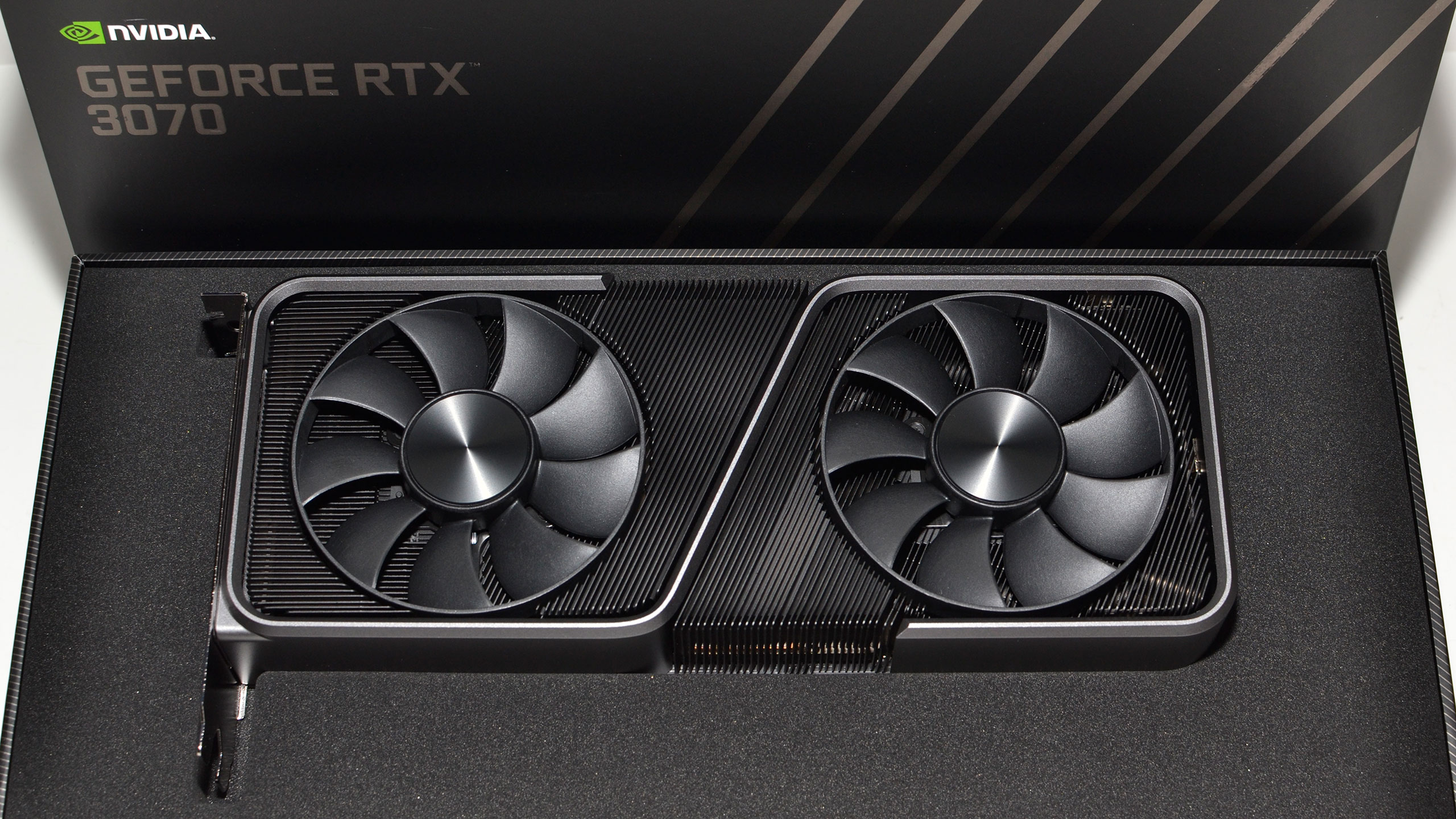
This review examines the NVIDIA GeForce RTX 3070 Founders Edition graphics card, a product meticulously crafted by NVIDIA itself. Unlike a traditional reference design, the Founders Edition aims to provide an enhanced version of the silicon, setting a higher standard for custom designs from board partners. The card is engineered to establish a benchmark that custom-designed cards aspire to meet. It employs the same “dual-axial flow-through” cooling system as seen in the RTX 3080 and RTX 3090 Founders Edition models, although both fans are positioned on one side. The second fan effectively facilitates airflow through the card due to a significant cutout in the backplate. Notably, NVIDIA has maintained the compact 12-pin power input, even though a single 8-pin connector would have sufficed given the board’s power requirement of 220 W. The provided adapter converts the 12-pin connection to a single 8-pin input.
This review examines the NVIDIA GeForce RTX 3070 Founders Edition, evaluating the company’s assertion that this graphics card outperforms the RTX 2080 Ti and its implications for the performance-segment market. Should this assertion prove accurate, it would mark the first instance since the 2016 “Pascal” generation where an NVIDIA performance-segment card surpasses a previous flagship model.