Holidays Notice: Deliveries and customer support will be unavailable from June 24 to June 26. Operations will resume on June 27. Thank you for your understanding.
Holidays Notice: Deliveries and customer support will be unavailable from June 24 to June 26. Operations will resume on June 27. Thank you for your understanding.
Holidays Notice: Deliveries and customer support will be unavailable from June 24 to June 26. Operations will resume on June 27. Thank you for your understanding.
Holidays Notice: Deliveries and customer support will be unavailable from June 24 to June 26. Operations will resume on June 27. Thank you for your understanding.
Holidays Notice: Deliveries and customer support will be unavailable from June 24 to June 26. Operations will resume on June 27. Thank you for your understanding.
Holidays Notice: Deliveries and customer support will be unavailable from June 24 to June 26. Operations will resume on June 27. Thank you for your understanding.
Holidays Notice: Deliveries and customer support will be unavailable from June 24 to June 26. Operations will resume on June 27. Thank you for your understanding.
Holidays Notice: Deliveries and customer support will be unavailable from June 24 to June 26. Operations will resume on June 27. Thank you for your understanding.
Today marks the launch of the GeForce RTX 4070 Ada by NVIDIA, and we present our review. The RTX 4070 (non Ti) stands out as the most economical option within the RTX 40-series, rendering it a crucial addition to the lineup. Priced at an entry point of, it promises to deliver optimal performance for 1440p gaming and the capability for 4K gaming at relatively high settings, potentially revitalizing the gaming market. Additionally, the inclusion of DLSS 3 serves as a powerful enhancement, enabling significantly improved framerates.
The GeForce RTX 4070 discussed in this review shares numerous similarities with the recently released RTX 4070 Ti, as both are constructed on a scaled-down variant of the same silicon architecture and feature an identical 12 GB of GDDR6X memory. However, the RTX 4070 operates within a significantly lower wattage category. Notably, several custom-designed RTX 4070 models, including some that are factory-overclocked, require only a single 8-pin PCIe power connector, resulting in a total power configuration of 225 W when accounting for the PCIe slot. Additionally, NVIDIA permits its board partners to utilize the newer ATX 12VHPWR power connector, which is capable of delivering substantially higher power levels.
The RTX 4070 is built upon the GeForce “Ada Lovelace” graphics architecture, which introduces the third generation of RTX technology developed by NVIDIA. This innovative technology enhances realism in gaming by integrating real-time ray tracing with traditional raster 3D graphics. The implementation of ray tracing demands significant computational power; therefore, NVIDIA has incorporated specialized hardware within the GPU to manage these tasks efficiently. The Ada architecture features the third generation of RT cores, which significantly improve ray tracing intersection performance, alongside fourth generation Tensor cores that enhance AI deep-learning neural networks by leveraging advanced capabilities. Additionally, the architecture includes Ada CUDA cores, increased GPU clock speeds, and a completely reengineered memory subsystem with expanded on-die caches. All these components are manufactured using the new TSMC 4N process, which combines 5 nm technology with 4 nm-class characteristics.
The GeForce RTX 4070 examined in this review utilizes the same AD104 silicon as the RTX 4070 Ti. However, while the RTX 4070 Ti fully utilizes the available hardware, the RTX 4070 is significantly reduced in capabilities. Specifically, the RTX 4070 is equipped with only 46 out of the 60 streaming multiprocessors (SM) that are physically available, resulting in a shader count that matches its predecessor, totaling 5,888 CUDA cores. Additionally, it includes 184 Tensor cores, 46 RT cores, 184 texture mapping units (TMUs), and 64 raster operation pipelines (ROPs) out of a possible 80. Fortunately, the memory configuration remains unchanged, providing 12 GB of 21 Gbps GDDR6X memory across a 192-bit memory bus, which delivers a bandwidth of 504 GB/s, surpassing the 448 GB/s offered by the RTX 3070.
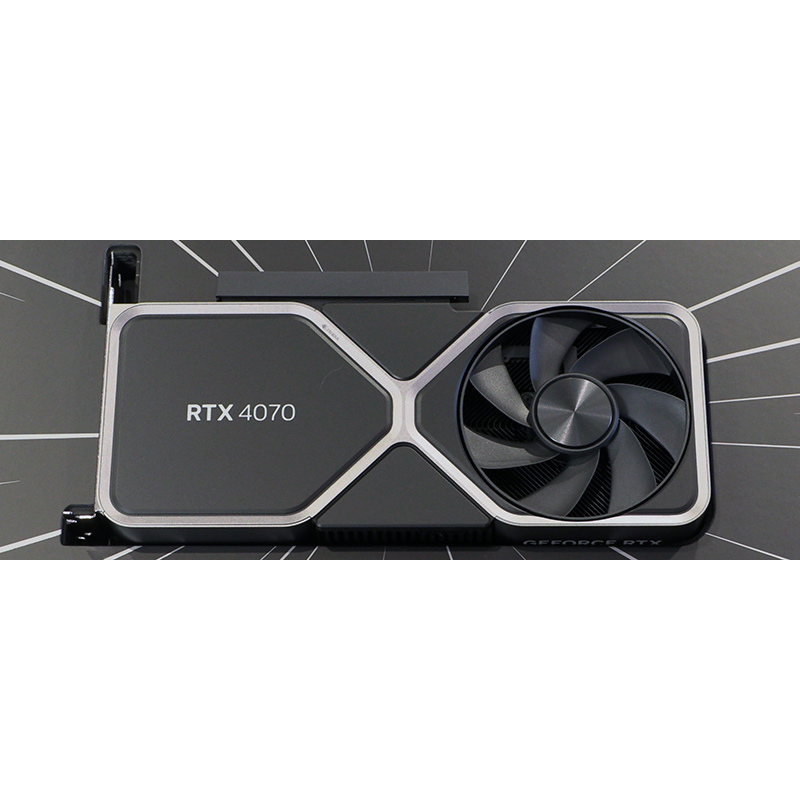
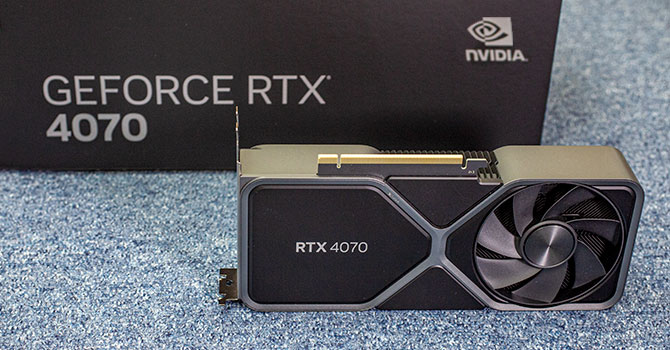
Although NVIDIA did not introduce a Founders Edition for the GeForce RTX 4070 Ti, they have developed one for the RTX 4070. The Founders Edition has evolved beyond a simple reference design to become a more premium offering, while still being available at the manufacturer’s suggested retail price.
The design of the RTX 4070 Founders Edition follows the Dual Axial Flow-through concept, similar to that of the RTX 3080 FE and the most recent RTX 4090 FE, albeit in a more compact configuration. Although NVIDIA permits its board partners to utilize traditional 8-pin power connectors, the Founders Edition is equipped with the 16-pin 12VHPWR connector, while maintaining the same clock speeds and power limits as the other graphics cards being evaluated today.